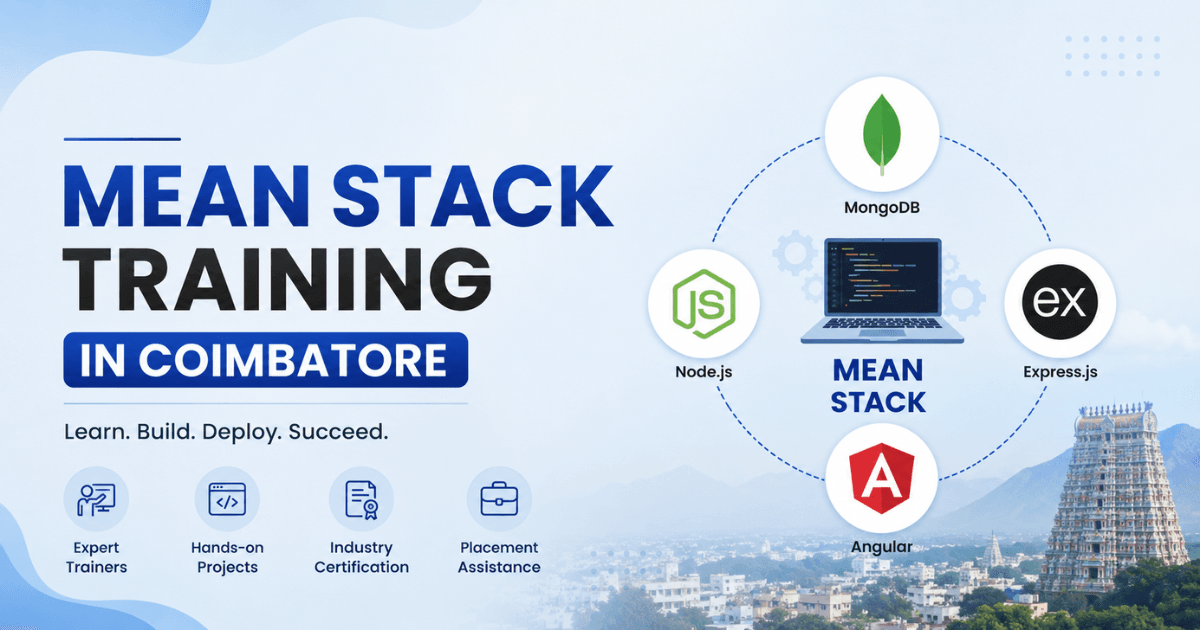
A MEAN Stack developer training program is a hands-on course that teaches MongoDB, Express.js, Angular, and Node.js — the four technologies used to build complete web applications with a single programming language, JavaScript. A good training program combines live classes, real projects, and career support, helping beginners become job-ready full stack developers in three to six months.
If you have been searching for a solid MEAN Stack course near Coimbatore, you are probably trying to answer one simple question: is this the right course to build a real career in web development?
That is exactly what this guide answers. No fluff, no exaggerated promises — just a clear, honest breakdown of what MEAN Stack is, why it matters in 2026, what a good training program should include, and how to judge whether a course (any course, anywhere) is actually worth your time and money.
By the end of this article, you will understand MongoDB, Express.js, Angular, and Node.js in plain language, see a complete learning roadmap, review real project ideas, and know exactly what to look for before enrolling in a mean stack training in coimbatore program.
Let's start from the basics.
What Is MEAN Stack Development?
MEAN Stack is a set of four JavaScript-based technologies used together to build complete, dynamic web applications:
- MongoDB – database
- Express.js – backend framework
- Angular – frontend framework
- Node.js – runtime environment
What makes MEAN Stack special is that a developer can build the entire application — database, server logic, and user interface — using one single language: JavaScript. This reduces the learning curve, speeds up development, and makes it easier to switch between frontend and backend work without constantly changing programming languages.
Companies like startups, product-based firms, and service-based IT companies use MEAN Stack because it is fast to build with, free and open-source, and backed by a massive developer community.
What Is mean stack training in coimbatore?
mean stack training in coimbatore refers to structured, classroom or online coaching programs offered in the city that teach students how to build full stack web applications using MongoDB, Express.js, Angular, and Node.js.
A genuine training program does more than explain theory. It typically includes:
-
✔
Step-by-step lessons on each of the four technologies
-
✔
Hands-on coding exercises after every concept
-
✔
Real-world project work, not just toy examples
-
✔
Guidance on REST APIs, authentication, and deployment
-
✔
Resume building, mock interviews, and placement support
Coimbatore has grown into a strong IT and education hub in Tamil Nadu, with a rising number of startups, product companies, and IT service providers setting up operations in the city. This has increased local demand for developers trained in modern JavaScript stacks, which is why so many students specifically search for a dedicated MEAN Stack program instead of a generic online course.
Why Learn MEAN Stack Development?
Here are the real reasons MEAN Stack continues to be relevant for developers in 2026:
One language, full application – JavaScript covers both frontend and backend, reducing context-switching.
High demand for JavaScript developers – Almost every product company uses JavaScript somewhere in its stack.
Faster development cycles – Reusable components and a unified language speed up build times.
Strong community and resources – MongoDB, Express, Angular, and Node.js all have active communities and extensive documentation.
Great foundation for other stacks – Once you understand MEAN, learning MERN, or other JavaScript-based stacks becomes much easier.
It's worth being honest here: MEAN Stack is not the only good stack to learn. But it is a proven, in-demand combination that gives you both frontend and backend skills, which is exactly what most companies look for in an entry-level full stack developer.
Who Should Join MEAN Stack Training?
MEAN Stack training works well for a wide range of learners:
- College students who want an industry-relevant skill alongside their degree
- Fresh graduates from any background, including non-CS branches
- Career switchers moving from unrelated fields into tech
- Working professionals who want to move into full stack roles
- Beginners with zero coding background but strong willingness to learn
- Support staff or testers who want to transition into development roles
The common thread is motivation, not background. Anyone willing to practice consistently for a few months can realistically pick up MEAN Stack development.
Skills Required Before Learning MEAN Stack
You do not need to be a programming expert before starting. However, having a basic understanding of the following helps you learn faster:
- Basic computer literacy and file handling
- Simple HTML and CSS concepts (can be taught at the start of training)
- Logical thinking and problem-solving mindset
- Basic understanding of how websites work (client, server, database)
- Willingness to practice coding daily, even for 30-45 minutes
If you're a complete beginner, a well-structured training program should start from HTML, CSS, and JavaScript fundamentals before moving into Angular and Node.js, so don't worry if you're starting from zero.
MEAN Stack Technology Explained
Let's break down each technology in the MEAN Stack individually, in beginner-friendly language.
MongoDB for Beginners
MongoDB is a NoSQL database, which means it stores data in flexible, JSON-like documents instead of rigid rows and columns like traditional SQL databases.
Practical Example: Think of MongoDB like a folder full of flexible forms, where each form (document) can have slightly different fields, instead of one strict spreadsheet that every entry must match exactly.
Key beginner concepts in MongoDB include:
- Documents and collections (similar to rows and tables in SQL)
- CRUD operations: Create, Read, Update, Delete
- Schema design using Mongoose (an Object Data Modeling library for Node.js)
- Indexing for faster queries
- Connecting MongoDB with a Node.js/Express backend
MongoDB's flexibility makes it a popular choice for applications where data structures change frequently, such as content management systems, e-commerce platforms, and social applications.
Express.js Explained
Express.js is a lightweight backend web framework built on top of Node.js. It handles the "server side" logic of your application — receiving requests from the browser, processing them, talking to the database, and sending back responses.
In simple terms, if Node.js is the engine, Express.js is the steering system that directs how requests flow through your application.
Core Express.js concepts covered in training include:
- Setting up routes and middleware
- Handling HTTP requests (GET, POST, PUT, DELETE)
- Building REST APIs
- Error handling and validation
- Connecting Express with MongoDB using Mongoose
Angular Framework Overview
Angular is a frontend framework maintained by Google, used to build dynamic, interactive user interfaces. Unlike plain JavaScript, Angular gives you a structured way to build large applications using components, services, and modules.
Angular can feel challenging at first because it introduces TypeScript, dependency injection, and a component-based architecture. However, with consistent practice and guided examples, most beginners become comfortable with Angular within four to six weeks of focused training.
Key Angular topics include:
- Components, templates, and data binding
- Directives and pipes
- Services and dependency injection
- Angular Router for navigation
- Forms (template-driven and reactive)
- Connecting Angular to backend APIs using HttpClient
Node.js Explained
Node.js is a JavaScript runtime environment that allows JavaScript to run outside the browser, typically on a server. This is what makes it possible to use JavaScript for backend development, not just frontend interactivity.
Node.js is known for being fast and efficient because of its non-blocking, event-driven architecture, which allows it to handle many simultaneous connections without slowing down.
Beginner-friendly Node.js topics include:
- Understanding the event loop
- Working with npm (Node Package Manager)
- Building a basic server
- Handling asynchronous operations (callbacks, promises, async/await)
- Integrating Node.js with Express and MongoDB
MEAN Stack vs MERN Stack Comparison
One of the most common questions beginners ask is whether to learn MEAN or MERN. Here's an honest, side-by-side comparison:
| Feature | MEAN Stack | MERN Stack |
|---|---|---|
| Frontend Framework | Angular | React |
| Backend | Express.js + Node.js | Express.js + Node.js |
| Database | MongoDB | MongoDB |
| Learning Curve | Slightly steeper (TypeScript, structure) | Slightly gentler (flexible, library-based) |
| Best For | Large, structured enterprise apps | Fast, flexible UI-driven apps |
| Job Demand | Strong, especially in enterprise/product firms | Very strong, widely used across startups |
| Community Size | Large | Very large |
Quick Answer: Is MERN better than MEAN? Neither is objectively "better" — they share the same backend (Express and Node.js) and database (MongoDB). The real difference is the frontend framework: Angular versus React. Companies with structured, large-scale applications often prefer Angular's opinionated architecture, while fast-moving startups often prefer React's flexibility. Learning one makes it significantly easier to pick up the other later.
Complete MEAN Stack Learning Roadmap
Here is a realistic, beginner-to-job-ready roadmap:
- Programming Fundamentals – Logic building, variables, loops, functions
- HTML – Structure and semantic markup
- CSS – Styling, layouts, responsive design (Flexbox/Grid)
- JavaScript – Core concepts, DOM manipulation, ES6+ features
- TypeScript – Types, interfaces, and Angular-ready syntax
- Angular – Components, services, routing, forms
- Node.js – Server-side JavaScript fundamentals
- Express.js – Routing, middleware, REST API design
- MongoDB – Database design, CRUD operations, Mongoose
- REST APIs – Connecting frontend and backend
- Authentication – JWT, sessions, and secure login flows
- Deployment – Hosting frontend and backend applications
- Capstone Project – A complete, portfolio-ready application
This roadmap typically takes three to six months to complete, depending on your pace, prior experience, and how many hours you can dedicate weekly.
MEAN Stack Course Curriculum
A well-designed MEAN Stack training program should follow a structured curriculum like this:
| Module | Topics Covered | Approx. Duration |
|---|---|---|
| Module 1 | HTML, CSS, JavaScript Fundamentals | 3 weeks |
| Module 2 | TypeScript & Angular Basics | 3 weeks |
| Module 3 | Advanced Angular (Routing, Forms, Services) | 2 weeks |
| Module 4 | Node.js Fundamentals | 2 weeks |
| Module 5 | Express.js & REST API Development | 2 weeks |
| Module 6 | MongoDB & Mongoose | 2 weeks |
| Module 7 | Authentication & Security | 1 week |
| Module 8 | Deployment & Version Control (Git/GitHub) | 1 week |
| Module 9 | Live Projects & Capstone Build | 3-4 weeks |
| Module 10 | Interview Preparation & Resume Building | 1-2 weeks |
This structure ensures learners aren't just memorizing syntax — they are building working applications at every stage.
Live Projects Included in MEAN Stack Training
Projects are what separate a resume that gets shortlisted from one that gets ignored. A solid training program should include:
Student Management System – CRUD operations, database design, admin dashboards
E-commerce Website – Product listings, cart, checkout, and order management
Hospital Management System – Appointment booking, patient records, role-based access
Employee Management System – HR workflows, attendance, and reporting modules
Task Management App – Kanban-style boards, task assignment, and status tracking
Real-Time Chat Application – WebSockets, live messaging, and notification systems
Building even two or three of these projects thoroughly — understanding every line of code, not just copying — gives you enough substance to talk confidently in technical interviews.
Career Opportunities After MEAN Stack Training
| Job Role | What You'll Do |
|---|---|
| Full Stack Developer | Build and maintain both frontend and backend of applications |
| Frontend Developer (Angular) | Focus on UI, user experience, and Angular-based interfaces |
| Backend Developer (Node.js) | Build APIs, manage databases, and handle server logic |
| Software Developer | General application development across the stack |
| Junior Web Developer | Entry-level roles supporting larger development teams |
| Freelance Web Developer | Independent client projects using MEAN Stack skills |
MEAN Stack skills are also valuable if you eventually want to move into technical roles like product engineering, DevOps-adjacent development, or team lead positions after gaining experience.
MEAN Stack Developer Salary in India
Salary figures vary significantly based on city, company size, and individual skill level, so treat these as general market ranges rather than guarantees:
| Experience Level | Approximate Annual Salary Range (India) |
|---|---|
| Fresher (0-1 year) | ₹2.5 LPA – ₹4.5 LPA |
| Junior Developer (1-3 years) | ₹4 LPA – ₹7 LPA |
| Mid-Level Developer (3-6 years) | ₹7 LPA – ₹14 LPA |
| Senior Developer (6+ years) | ₹14 LPA and above |
These ranges depend heavily on your project portfolio, communication skills, and how well you perform in technical interviews — not just on completing a course. No training program, including ours, can guarantee a specific salary or placement outcome, and you should be cautious of any institute that promises one.
How to Choose the Best MEAN Stack Training Institute
Choosing the right mean stack training in coimbatore program is arguably more important than the technology itself. Use this checklist before enrolling anywhere:
-
✔
Does the curriculum match the roadmap above, covering all four MEAN technologies in depth?
-
✔
Are classes hands-on, with live coding, not just slide-based lectures?
-
✔
Does the program include real, non-trivial projects?
-
✔
Are trainers currently working or recently experienced in the industry?
-
✔
Is there a doubt-clearing or mentorship system?
-
✔
Does the institute provide resume support and mock interviews?
-
✔
Are batch sizes small enough for individual attention?
-
✔
Can you talk to past students or see verifiable project work?
-
✔
Is the fee structure transparent, with no hidden charges?
-
✔
Does the institute avoid making unrealistic salary or placement guarantees?
If a program checks most of these boxes, it's a strong candidate — regardless of which city or institute you're evaluating.
Software Training Institutes by City
Software Training Institute in Coimbatore
Coimbatore has become one of Tamil Nadu's fastest-growing technology and education hubs, home to a mix of IT parks, startups, and established software companies. Because of this, the demand for a good Software training institute in Coimbatore has grown steadily over the past few years.
When evaluating any such institute in the city, look beyond flashy advertisements. Visit in person if possible, ask to see sample project work from alumni, and check whether the trainers can answer deep technical questions confidently. A genuinely good institute will always be transparent about its curriculum, trainer background, and realistic outcomes.
Software Training Institute in Chennai
Chennai, as one of South India's largest IT hubs, naturally has a large concentration of training institutes as well. If you're comparing a Software training institute in Chennai against options in Coimbatore, the evaluation criteria remain the same: curriculum depth, trainer experience, project quality, and honest communication about outcomes.
Many students from smaller towns move to Chennai specifically to attend such an institute, assuming a bigger city automatically means better training. That's not always true — a smaller, well-run institute with experienced mentors can often deliver better learning outcomes than a large, impersonal one.
Software Training Institute in Madurai
Madurai is also emerging as a growing education and IT center in Tamil Nadu, with several institutes now offering technical training programs. A Software training institute in Madurai can be a good option for students in the region who prefer to learn closer to home before considering relocation for job opportunities.
As with Coimbatore and Chennai, the same due-diligence checklist applies when evaluating such an institute — curriculum quality matters far more than location or marketing claims.
Why Practical Training Matters
Reading about MongoDB, Express.js, Angular, and Node.js is not the same as building with them. Practical, hands-on training matters because:
- Debugging real errors teaches you far more than watching solved examples
- Building complete projects forces you to connect concepts (frontend, backend, database) instead of learning them in isolation
- Technical interviews almost always include practical coding or project-explanation rounds
- Employers value candidates who can demonstrate working applications, not just certificates
If a training program is 80% theory and 20% practice, you will likely struggle once you start job hunting. The ratio should ideally be reversed.
How Crud Academy Helps Students Become Industry Ready
At Crud Academy, our approach to mean stack training in coimbatore is built around one core idea: students should be building real applications from the very first few weeks, not just watching lectures.
Our program focuses on:
- ✔
A structured curriculum that mirrors the roadmap covered earlier in this guide
- ✔
Trainers with hands-on industry development experience
- ✔
Project-first learning, including full applications like e-commerce platforms and management systems
- ✔
Doubt-clearing sessions and mentorship throughout the course
- ✔
Resume building and interview preparation support before course completion
We don't promise guaranteed placements or unrealistic salary figures — what we do promise is a genuinely practical learning environment where you leave with real project experience, not just a certificate. If you're evaluating options for MEAN Stack training near you, we'd encourage you to use the institute checklist above on us too, and ask us the hard questions directly.
Frequently Asked Questions
What is MEAN Stack Development? +
MEAN Stack Development is the process of building full web applications using four JavaScript-based technologies: MongoDB (database), Express.js (backend framework), Angular (frontend framework), and Node.js (runtime environment). Since all four use JavaScript, developers can work across the entire application — from database to user interface — without switching programming languages. This makes MEAN Stack a popular choice for building scalable web applications, admin dashboards, and enterprise-grade software efficiently.
Is MEAN Stack good for beginners? +
Yes, MEAN Stack is beginner-friendly if taught in the right sequence. Starting with HTML, CSS, and JavaScript basics before moving to TypeScript, Angular, Node.js, and MongoDB makes the learning curve manageable. Angular does have a steeper initial learning curve compared to simpler libraries, but with structured, hands-on training and consistent practice, most beginners become comfortable within a few weeks. Prior coding experience helps but is not mandatory to start learning.
How long does it take to learn MEAN Stack? +
On average, it takes three to six months to become job-ready in MEAN Stack, depending on your prior background, the number of hours you practice weekly, and the quality of your training program. Complete beginners with no coding background may need closer to five or six months, including time spent on HTML, CSS, and JavaScript fundamentals before starting the core MEAN technologies.
What are the prerequisites for MEAN Stack? +
There are no strict prerequisites, but basic computer literacy and a willingness to learn logical problem-solving help significantly. Some familiarity with HTML and CSS is useful but can also be taught at the beginning of a structured course. The most important prerequisite is consistency — practicing coding regularly matters far more than any prior technical background.
Is Angular difficult to learn? +
Angular has a steeper learning curve than some other frontend frameworks because it introduces TypeScript, dependency injection, and a structured component architecture. However, this structure is also what makes Angular powerful for large applications. With guided, project-based training and consistent practice, most learners become comfortable with core Angular concepts within four to six weeks.
Which is better, MERN or MEAN Stack? +
Neither stack is objectively better — they share the same backend (Node.js and Express.js) and database (MongoDB). The difference lies in the frontend: MEAN uses Angular, while MERN uses React. Angular suits large, structured enterprise applications, while React offers more flexibility for fast-moving projects. Learning either stack gives you a strong foundation to pick up the other one later with relatively little extra effort.
Can non-IT students learn MEAN Stack? +
Yes, students from non-IT and even non-engineering backgrounds regularly learn MEAN Stack successfully. What matters most is logical thinking, consistency in practice, and a willingness to work through debugging challenges. A structured training program that starts from programming fundamentals makes it entirely possible for commerce, arts, or science graduates to transition into full stack development roles.
What projects should beginners build? +
Beginners should start with smaller CRUD-based projects like a student management system, then progress to more complex applications such as an e-commerce website, task management app, or real-time chat application. Building projects that combine authentication, database operations, and API integration gives beginners the practical experience needed to confidently discuss their work in technical interviews.
Will I get placement after MEAN Stack training? +
Placement outcomes depend on multiple factors, including your project portfolio, communication skills, interview performance, and current market conditions — no training institute can honestly guarantee placement. What a good program can offer is strong technical preparation, resume support, mock interviews, and exposure to real projects, which meaningfully improves your chances in the job market.
What is the salary of a MEAN Stack Developer? +
In India, freshers typically start in the range of ₹2.5 LPA to ₹4.5 LPA, while developers with one to three years of experience often earn between ₹4 LPA and ₹7 LPA. Mid-level and senior developers with proven project experience can earn significantly more. These figures vary by city, company, and individual skill level, so they should be treated as general market indicators rather than guarantees.
Which institute offers the best MEAN Stack training? +
The "best" institute depends on curriculum depth, trainer experience, project quality, and how honestly it communicates outcomes — not just marketing claims. Rather than looking for a universally "best" answer, use a practical checklist: verify the curriculum, ask about trainer background, request sample projects from alumni, and confirm there are no unrealistic guarantees before enrolling in any mean stack training in coimbatore program.
Why should I learn MEAN Stack in 2026? +
JavaScript continues to dominate both frontend and backend development in 2026, and MEAN Stack remains a strong, proven combination for building scalable web applications. Learning it gives you full stack capability with a single language, strong community support, and a solid foundation that makes learning additional frameworks like React significantly easier later in your career.
Final Thoughts
MEAN Stack Development remains one of the most practical, in-demand skill combinations for anyone serious about a full stack developer career. It teaches you to think across the entire application — database, server, and user interface — using a single, widely-used language: JavaScript.
If you're searching for a reliable MEAN Stack course, don't just choose based on advertisements or promised outcomes. Use the checklist covered in this guide: verify the curriculum, check trainer experience, ask about real project work, and be wary of any institute making unrealistic salary or placement claims.
At Crud Academy, we've built our mean stack training in coimbatore program around exactly these principles — practical, project-first learning with honest guidance every step of the way. If you'd like to see our curriculum in detail or speak with our trainers before enrolling, we're happy to walk you through it.
Ready to start your full stack developer journey?
Explore our MEAN Stack course details and talk to our team about your learning goals today.
Explore the MEAN Stack Course